
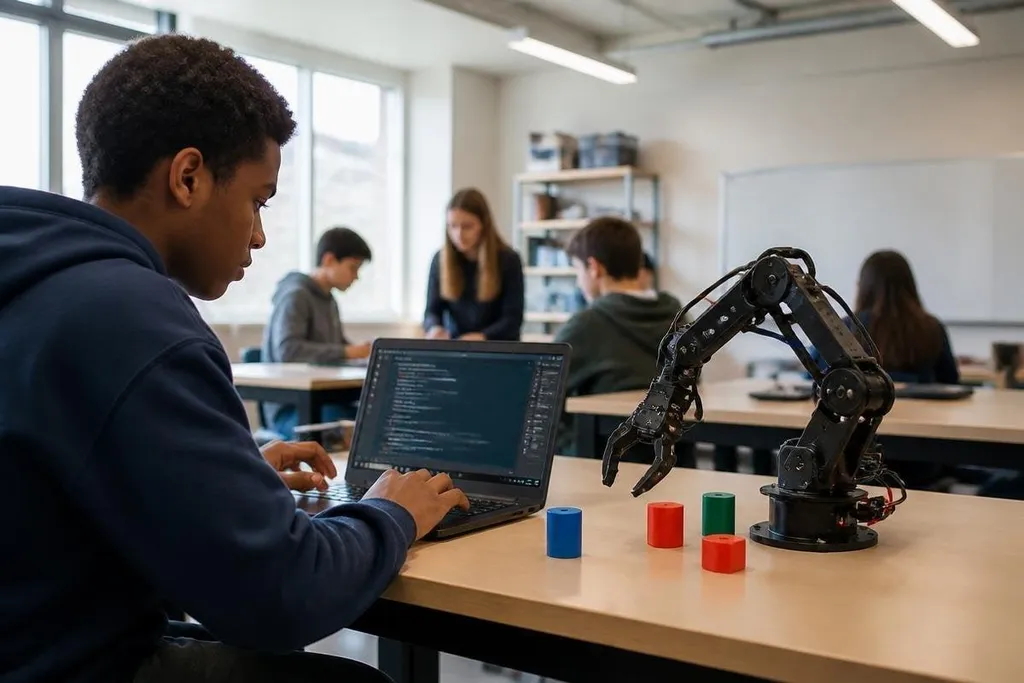
A classroom robot can turn a line of code into a moving arm, a failed turn, or a missed object. That link between software and physical results explains why educational robots matter as automation reaches more workplaces.
- Students see how sensors, motors, and code work together.
- Teachers can use one robot for lessons in coding, design, and safety.
- A failed task gives students a result they can measure and fix.
Robots make abstract lessons physical
A programming lesson can stay inside a screen. A robot changes the test. The student writes code, sends it to the robot, and watches the result happen in front of them.
That process makes errors easier to discuss. If a wheeled robot turns too early, the class can check its sensor reading, wheel speed, or stopping rule. The problem has a visible cause, so students have something concrete to measure.
The same setup can teach several parts of a robotics system. Sensors collect data, software makes a decision, and motors carry out that decision. Students learn that a robot does not “understand” a room in the human sense. It follows rules built from measurements.
This matters for teachers, too. A working robot gives a lesson a clear result without requiring a large lab. One small platform can support tasks in geometry, physics, computer science, and product design.
Failure becomes part of the lesson
Educational robots also give students a safe place to meet failure. A program may send the robot in the wrong direction, or a gripper may drop an object because the force setting is too low. The class can change one part, run the test again, and compare the results.
That loop matches the work of robotics teams. Engineers check a system, find the part that failed, change the design, and test again. Students learn that a robot project is built from many small checks rather than one perfect first attempt.
The lesson works best when teachers ask students to record what changed between tests. A simple table with the code version, sensor reading, task result, and next change can turn trial and error into careful work.
The link to workplace skills
Factories, farms, hospitals, and warehouses use machines that combine software with physical movement. Students who work with educational robots meet the same broad ideas early: sensing a space, planning a movement, checking safety, and deciding what a person must still do.
That does not mean a classroom robot prepares someone for one job. The useful skill is learning how to break a task into steps and test each step. Those habits transfer to automation, maintenance, software, and system design.
Reports on Robot 24 can connect classroom tasks with named machines, their jobs, and the limits shown in testing. That comparison helps you see where school exercises prepare students for industrial work, and where the two settings split.
The gap between a school kit and a factory robot still needs care. A classroom platform may move slowly, work in a clean room, and run only one planned task. Industrial systems must handle dust, changing loads, safety rules, service work, and long operating periods.
Students should learn that gap rather than skip over it. A robot that works in a lesson has passed one test. It has not proved that the same design can run safely beside people for a full shift.
What schools should check before buying
A useful robot should fit the lesson, the teacher’s time, and the school’s repair budget. Check these points before choosing a platform:
- Lesson fit: name the task students will complete, such as mapping a room or sorting objects.
- Code access: confirm that students can read and change the program rather than press one preset button.
- Physical access: check whether learners can reach the battery, sensors, wheels, and emergency stop.
- Repair plan: find out which parts the school can replace and how long common parts take to arrive.
- Safety controls: look for speed limits, low-force movement, and a clear way to stop the robot.
The strongest classroom work usually comes from a small task with a clear result. Students can compare two paths, test how a sensor reacts to distance, or change a gripper setting and record what happens. The robot does not need a human-shaped body to teach useful engineering.
What happens next
I’d fund teacher training and spare parts before buying a more complex robot. A basic platform used well can teach sensing, code, testing, and safety; a costly machine that stays in its box teaches none of them.
As automation grows, schools will need lessons that show where machines work, where they fail, and where people remain responsible.
The useful question is not whether every classroom needs a robot, but whether students get enough chances to test a real system before they meet one at work.